For ports, offshore projects, and marine towing operations that demand precise thrust control, Haiding Shipbuilding provides the Controllable Pitch Propeller Tug as a configurable propulsion solution. By adjusting propeller blade pitch through a hydraulic control system, the tug can regulate thrust without changing the main engine's rotational speed or direction, supporting efficient towing, rapid maneuvering, and reliable operation across changing working conditions.
A controllable pitch propeller tug uses a controllable pitch propeller (CPP) to continuously adjust propulsion thrust by changing the angle of its propeller blades. This design allows operators to switch efficiently between towing, cruising, standby, pushing, and other operating conditions while maintaining a suitable engine speed. Haiding Shipbuilding's solution features hydraulic pitch adjustment, bridge remote control, PLC-integrated control, reinforced hull protection, corrosion-resistant treatment, and customizable power configurations from 500 to 8000 HP. Depending on the selected configuration, the tug can provide 30–120 tons of bollard pull and support demanding port, coastal, offshore, and emergency operations.
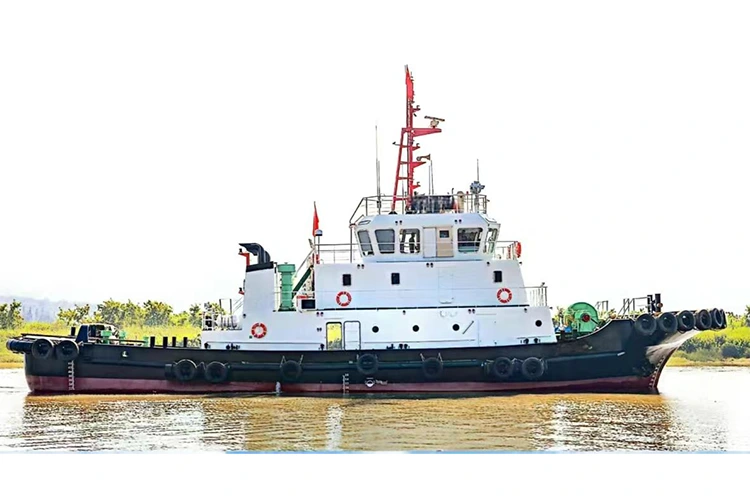
Table of Contents
- What Is a Controllable Pitch Propeller Tug?
- How Does the CPP Propulsion System Work?
- What Are the Key Technical Features?
- What Performance Benefits Can Operators Expect?
- What Are the Main Specifications?
- Where Can This Tug Be Used?
- How Should Buyers Select the Right Tug?
- How Can Maintenance and Service Reliability Be Improved?
- Frequently Asked Questions
- Conclusion
What Is a Controllable Pitch Propeller Tug?
A Controllable Pitch Propeller Tug is a marine towing vessel equipped with a controllable pitch propeller. Unlike a conventional fixed-pitch propeller, a CPP system allows the propeller blade angle to be changed while the main engine continues operating within an appropriate speed range.
The fundamental purpose is simple: give the operator more direct control over thrust. Instead of relying primarily on engine-speed changes or mechanical reversing arrangements, the CPP system adjusts blade pitch to increase, reduce, or reverse thrust. This makes the configuration particularly useful for tugboats that frequently transition between different operating conditions.
According to the product information supplied by Haiding Shipbuilding, its CPP tug uses four core components: a propeller hub, adjustable blades, a pitch adjustment mechanism, and a hydraulic control system. The propeller blades can be adjusted through a stated range of approximately -30° to +30°, while hydraulic pistons inside the propeller hub control pitch adjustment.
How Does the CPP Propulsion System Work?
The operating principle of a controllable pitch propeller is based on changing blade geometry rather than constantly changing engine speed. The hydraulic system moves the pitch mechanism inside the propeller hub, causing each blade to rotate around its axis.
This process enables the propulsion system to adapt to changing resistance and thrust requirements. During towing, a larger positive pitch can generate strong forward thrust. During cruising, the pitch can be optimized for efficient propulsion. For deceleration or reverse operation, the pitch can be moved toward a negative setting without requiring the main engine to reverse its rotational direction.
Haiding Shipbuilding specifies a hydraulic response time of no more than one second for the core control system, while the broader control configuration lists a response speed of up to 0.5 seconds. These figures are intended to support rapid operational changes and precise maneuvering.
- Thrust adjustment: Propeller blade pitch changes continuously according to operating requirements.
- Hydraulic actuation: Hydraulic pistons drive the pitch mechanism inside the propeller hub.
- Bridge control: Operators can control propulsion directly from the bridge.
- Engine optimization: The main engine can remain within a suitable operating-speed range.
- Rapid reversing: Reverse thrust can be achieved by changing propeller pitch rather than reversing engine rotation.
What Are the Key Technical Features?
A commercial tug needs more than propulsion power. It must also withstand repeated towing loads, vessel contact, saltwater exposure, changing weather conditions, and intensive operating schedules. For this reason, the propulsion system is only one part of a complete tugboat configuration.
Hydraulic Pitch Control
The hydraulic pitch mechanism provides continuous control over propeller blade angle. This helps the tug respond to different thrust requirements without relying exclusively on engine-speed changes.
PLC-Integrated Control
The product configuration incorporates a PLC-integrated precision control system. This supports centralized operational control and can reduce the amount of manual adjustment required during changing work conditions.
Reinforced Hull Protection
Reinforced anti-collision fenders are designed to protect the tug and surrounding structures during berthing and close-quarters operations. The hull is specified as high-strength special steel, with the product page indicating compliance with CCS strength and rigidity requirements.
Marine Anti-Corrosion Treatment
Marine vessels operate continuously in humid and salt-spray environments. The specified coastal anti-corrosion coating helps isolate the hull from corrosive exposure and supports long-term serviceability.
What Performance Benefits Can Operators Expect?
The major advantage of CPP propulsion is operational flexibility. A tug does not perform one single task throughout its working day. It may move from standby to towing, assist a large vessel during berthing, perform short-distance repositioning, and later participate in emergency operations.
By allowing propeller pitch to be matched to the current operating condition, the system can help maintain propulsion efficiency across these transitions. Haiding Shipbuilding states that its CPP configuration can reduce fuel consumption by approximately 10%–15% under applicable operating conditions. The manufacturer also states that stable engine loading can reduce wear and extend the maintenance cycle.
- More precise thrust management during towing.
- Faster transition between forward and reverse thrust.
- Better adaptation to towing, cruising, and standby conditions.
- Potential fuel-saving benefits when the pitch is optimized for the operating condition.
- Reduced dependence on mechanical reversing arrangements.
- Improved suitability for operations involving frequent changes in propulsion demand.
For operators comparing propulsion technologies, it is important to evaluate these benefits together with vessel size, duty cycle, water conditions, engine selection, propeller diameter, and expected bollard pull rather than judging propulsion efficiency from a single specification.
What Are the Main Specifications?
The following specifications summarize the principal configuration information published for the Haiding Shipbuilding Controllable Pitch Propeller Tug. Actual vessel specifications can vary according to customization requirements and operating conditions.
| Configuration | Specification | Operational Significance |
|---|---|---|
| Power Range | 500–8000 HP | Supports different port and towing requirements |
| Bollard Pull | 30–120 tons / 294–1176 kN | Provides strong towing force for heavy marine operations |
| Propeller Pitch | Approximately -30° to +30° | Enables adjustable forward and reverse thrust |
| Control System | PLC-integrated precision control | Supports centralized and accurate operation |
| Control Response | Up to 0.5 seconds in specified configuration | Facilitates rapid operational changes |
| Positioning Accuracy | ±0.3 m | Supports precise vessel positioning |
| Hull Material | High-strength special steel | Provides structural strength and rigidity |
| Service Life | ≥15 years | Designed for long-term marine operation |
| Warranty | 2 years for core components | Provides additional technical and maintenance support |
| Certification | CCS and ISO international maritime certifications | Supports compliance with applicable marine requirements |
Potential buyers should confirm the final technical specification, classification requirements, engine package, propulsion arrangement, and performance targets before placing an order.
Where Can This Tug Be Used?
A controllable pitch propulsion system is particularly valuable where operating conditions change frequently. The Haiding Shipbuilding configuration is designed for several marine applications.
Port and Harbor Operations
Tugs can assist large vessels during berthing and departure, reposition vessels within restricted areas, and provide controlled pushing or towing assistance. Precise thrust control is especially useful when working close to docks, terminals, and other vessels.
Offshore Engineering
Offshore construction and energy projects can require towing drilling platforms, work vessels, equipment, or floating structures. The product information identifies drilling-platform transfer and offshore engineering towing among its applicable scenarios.
Coastal Towing
Long-distance coastal towing can involve changing load conditions, weather, and vessel resistance. Adjustable pitch allows propulsion output to be adapted as operating conditions change.
Emergency Rescue
Tugboats may also support emergency response, firefighting, pollution control, or rescue operations. Optional configurations include external firefighting systems and oil-spill recovery equipment.
For additional vessel options, buyers can also review the Haiding Shipbuilding tugboat range, including fixed pitch, vertical stern, and Z-drive configurations.
How Should Buyers Select the Right Tug?
Choosing a commercial tug should begin with the actual operating profile rather than a generic horsepower target. A higher engine rating does not automatically mean that a vessel is better suited to a particular job.
Before purchasing, buyers should evaluate:
- Required bollard pull: Determine the towing force required for the largest expected vessel or load.
- Operating environment: Consider harbor, coastal, offshore, inland, or open-water conditions.
- Duty cycle: Estimate how often the vessel will tow, cruise, push, stand by, or perform emergency work.
- Water depth and maneuvering space: These factors influence propulsion and steering configuration.
- Classification requirements: Confirm the applicable classification society and regulatory requirements.
- Maintenance resources: Evaluate spare parts availability, technical support, crew capability, and service response.
- Future customization: Consider whether additional firefighting, pollution-control, or other modules may be required later.
A qualified manufacturer should be able to translate these operational requirements into an appropriate hull, power, propulsion, control, safety, and auxiliary-equipment configuration.
How Can Maintenance and Service Reliability Be Improved?
Propulsion reliability directly affects vessel availability. A CPP system contains mechanical, hydraulic, and control components, so preventive maintenance should cover the complete propulsion chain rather than the propeller alone.
- Inspect hydraulic lines, seals, and actuators for leakage or abnormal wear.
- Monitor propeller hub and blade condition during scheduled inspections.
- Check control-system response and pitch feedback regularly.
- Inspect hull coatings and anti-corrosion protection in saltwater environments.
- Maintain critical spare parts according to the vessel's duty cycle.
- Follow the manufacturer's recommended inspection and maintenance intervals.
- Keep operating records to identify recurring propulsion or control-system issues.
Haiding Shipbuilding states that its core components are covered by a two-year warranty and that service support includes local service outlets and 24-hour response. Buyers should confirm the exact service scope, warranty conditions, spare-parts arrangements, and commissioning support within the final commercial contract.
Frequently Asked Questions
What is the main advantage of a controllable pitch propeller tug?
The primary advantage is adjustable thrust. The propeller blade angle can be changed without changing the main engine's rotational direction, allowing the tug to respond quickly to different towing, maneuvering, cruising, and standby requirements.
What is the power range of the Haiding Shipbuilding CPP tug?
The published configuration supports a modular power range of approximately 500–8000 HP. The appropriate power level should be selected according to vessel size, required bollard pull, operating environment, and duty cycle.
What bollard pull can the tug provide?
The listed bollard pull range is approximately 30–120 tons, equivalent to about 294–1176 kN. Final performance depends on the vessel configuration and selected propulsion package.
Can a CPP tug operate in narrow port waters?
Yes, the configuration is intended for port operations requiring controlled thrust and maneuvering. The final maneuverability of a tug depends on its complete propulsion and steering arrangement, hull design, draft, and operating environment.
Is the CPP tug suitable for offshore towing?
Yes. Offshore engineering towing, including drilling-platform transfer, is identified as one of the applicable scenarios. Buyers should specify the expected offshore conditions and towing loads when requesting a vessel configuration.
Can the tug be customized?
Yes. The published product information indicates support for power upgrades, additional functional modules, and adaptation to special operating environments. Firefighting and oil-spill recovery equipment can also be incorporated according to project requirements.
Conclusion
A Controllable Pitch Propeller Tug provides a flexible propulsion solution for marine operations where thrust control, maneuverability, and changing load conditions are critical. Its adjustable propeller pitch allows operators to manage propulsion output without constantly changing main-engine speed or rotational direction. With configurable power from 500 to 8000 HP, a listed bollard-pull range of 30–120 tons, PLC-based control, reinforced hull protection, anti-corrosion treatment, and optional safety and environmental modules, the Haiding Shipbuilding solution can be configured for port assistance, coastal towing, offshore engineering, and emergency operations.
If you are evaluating a tugboat for a new port, offshore project, coastal towing fleet, or specialized marine application, define your required bollard pull, working environment, duty cycle, propulsion requirements, and optional functions first. Then work with an experienced China tugboat manufacturer to develop a configuration that matches the actual operating profile. For technical specifications, customization options, project consultation, and quotation support, contact us at Haiding Shipbuilding to discuss your requirements and obtain a suitable Controllable Pitch Propeller Tug solution.