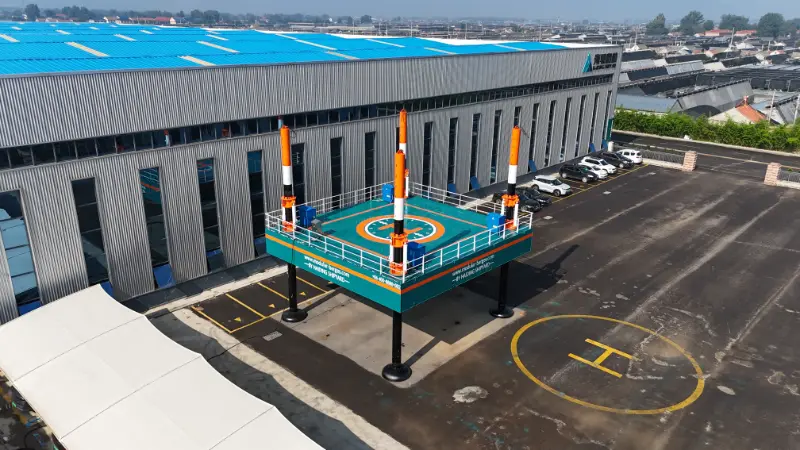
Jack Up Wind Farm Installation Platform
Offered by HAIDING SHIPYARD, this Jack Up Wind Farm Installation Platform serves buyers requiring robust offshore lifting capabilities. Built for 16MW+ turbines in 3–100m depths, it features an 800t crane, 150m legs, and 3,000t payload in modular, transportable sections. As a China supplier with over three decades of shipbuilding experience, we deliver modular, transportable solutions that can be road-shipped and rapidly assembled at project sites worldwide.
As a trusted China supplier to global marine contractors, HAIDING SHIPYARD designed the Jack Up Wind Farm Installation Platform to protect heavy turbine alignment against wave action. An 800t dual-winch crane (±0.1m sync) works with ±0.05° auto-leveling hydraulics on a CCSB steel hull to prevent deck sway.
Why Offshore Wind Developers Are Moving Away from Floating Cranes?
The offshore wind industry has learned a costly lesson: floating crane vessels, while flexible in water depth, are fundamentally limited by wave-induced motion. A floating crane bobbing in swells cannot achieve the millimeter-level alignment required for tower-to-nacelle mating. Every wave-induced deviation adds time, risk, and cost to the installation process.
Our Jack Up Wind Farm Installation Platform eliminate this variable entirely. By raising the hull above the water surface on spud legs—a feature that gives these vessels their alternative name—the platform transforms from a moving ship into a fixed, stable work platform. This stability is not a luxury; it is a prerequisite for installing 16MW turbines where the nacelle alone weighs upwards of 600 tons and must be docked onto a tower with coaxiality deviation under 1mm.
A single turbine installation cycle on this platform is ≤72 hours, a 40% efficiency gain over traditional floating crane operations. In a 50-turbine wind farm, that translates to weeks of saved vessel time and millions in reduced charter costs.


800-Ton Crane Integration: Built for the Next Generation of Turbines
The platform's core lifting asset is a full-hydraulic 360° slewing crane with a maximum rated capacity of 800 tons at a 45-meter working radius. The main hook provides a lifting height of ≥120 meters, with the auxiliary hook reaching ≥150 meters—sufficient clearance for 16MW turbine nacelles (weight ≤600 tons) and 70-meter tower sections (single-section weight ≤300 tons).
What makes this crane different from standard offshore cranes?
• Dual-winch synchronous control with ±0.1m synchronization accuracy ensures that when lifting asymmetric loads—such as a nacelle with offset center of gravity—both winches spool in perfect unison, preventing load swing that could damage the tower or compromise personnel safety.
• Wind turbine-specific spreaders adapt to different nacelle and tower specifications, while hydraulic jacking devices provide ±0.05m adjustment accuracy for final docking alignment.
• Laser leveling interfaces work with the platform's leveling system to ensure pile foundation top horizontal error ≤0.1°, eliminating the need for costly rework during turbine mounting.
The crane is not an afterthought bolted onto a barge; it is fully integrated into the platform's structural design, with the crane base area engineered for ≥150kN/㎡ deck load and stress monitoring points (CCSB steel plate stress ≤200MPa) providing real-time data on structural integrity during heavy lifts.
What Happens When the Platform Can't Stay Level?
This is the question that keeps project managers awake at night. A platform that drifts off-level during a 600-ton nacelle lift creates a cascading failure risk: the crane's load radius changes, the tower may be struck, and the entire lift could be aborted, wasting hours of expensive vessel time.
The Jack Up Wind Farm Installation Platform addresses this with a three-axis inclination sensor (accuracy ±0.02°) paired with a GPS+Beidou dual positioning system (positioning accuracy ≤0.5m). Before each hoist, the platform automatically levels itself to within ±0.05°. During the lift, the system continuously compensates for any platform tilt caused by wind and wave action (compensation speed ≤0.1m/min), ensuring the main engine hoisting positioning deviation stays ≤0.5m.
Dynamic load monitoring provides an additional layer of safety. High-precision load sensors (accuracy ±1%) and torque limiters monitor hoisting weight and torque in real time. The system automatically alarms when loads approach 90% of rated capacity and forcibly stops the operation if the rated value is exceeded. This is not a theoretical safety feature—it is a hard-wired failsafe that has prevented countless overloading incidents in offshore operations.
From Factory Floor to Wind Farm: The Modular Transport Advantage
One of the most overlooked challenges in offshore wind is not installation—it is getting the installation platform to the site in the first place. Traditional wind turbine installation vessels (WTIVs) are massive, single-piece hulls that require deep-water ports and specialized dry docks for construction and maintenance.
This Jack Up Wind Farm Installation Platform takes a different approach. The structure is split into 7 to 9 sections (main platform, spud leg sections, crane module), with each section welded from CCSB steel plate and weighing no more than 150 tons. This modular design enables:
• Road and rail transport: Sections can be trucked or railed to inland assembly points, eliminating the need for deep-water port access during manufacturing.
• Global shipping: Sections are transported via semi-submersible ships and ocean-going barges to project sites worldwide.
• On-site assembly: Flanges and prestressed bolts complete the assembly in 12 to 18 days using marine floating cranes—30% faster than the deployment cycle of traditional WTIVs.
For projects in remote locations or regions without established offshore infrastructure, this modular approach transforms what was once a logistical nightmare into a manageable, predictable process.
Built to Withstand: CCSB Steel and Deep-Sea Durability
The Jack Up Wind Farm Installation Platform's main structure is fabricated from CCSB marine steel plate, a material certified by the China Classification Society (CCS) for offshore applications. With a yield strength of ≥235MPa and tensile strength of 400–520MPa, CCSB steel provides the structural rigidity required for heavy-lift operations while maintaining ductility for impact resistance.
Detailed Technical Parameters
|
Parameter Category |
Specific Item |
Specification Range |
Remarks |
|
Basic Dimensions |
Total Platform Length (m) |
80-100 |
7-9 sections, single section length ≤15m |
|
|
Total Platform Width (m) |
30-35 |
Effective deck operation area ≥65% (including crane module) |
|
|
Platform Depth (m) |
7.0-8.0 |
Ensures crane installation and equipment storage space |
|
Lifting Performance |
Number/Type of Spud Legs |
4/truss-type |
Diameter 2.8-3.5m, material: CCSB marine steel plate |
|
|
Spud Leg Length (m) |
50-150 |
Adapted to 3-100m water depth, customizable |
|
|
Lifting Speed (m/min) |
0.2-0.4 |
Full-load lifting speed ≥0.2m/min |
|
|
Seabed Insertion Depth (m) |
≥10 |
Expandable spud can optional for soft soil (contact area ≥100㎡, CCSB steel plate) |
|
Hoisting Performance |
Crane Rated Lifting Capacity (t) |
≤800 |
360° slewing, maximum working radius 45m |
|
|
Crane Lifting Height (m) |
Main hook ≥120, Auxiliary hook ≥150 |
Adapted to 16MW wind turbine main engine installation |
|
|
Hoisting Synchronization Accuracy (m) |
±0.1 |
Dual winch synchronous control |
|
|
Docking Adjustment Accuracy (m) |
±0.05 |
Hydraulic jacking device adjustment |
|
Load Performance |
Total Platform Load (t) |
3000 |
Including crane, wind power equipment, personnel and materials |
|
|
Deck Uniform Load (kN/㎡) |
80-90 |
Crane base area load ≥150kN/㎡ |
|
|
Wind Power Equipment Adaptation Weight (t) |
Main engine ≤600, Single tower barrel section ≤300 |
Adapted to 16MW and above wind turbine models |
|
Structure & Material |
Platform Material |
Main structure: CCSB marine steel plate; Deck: CCSB wear-resistant modified steel plate |
Main load-bearing beam thickness ≥60mm, yield strength ≥235MPa |
|
|
Anti-corrosion Treatment |
Deep-sea heavy anti-corrosion coating + cathodic protection |
Underwater anti-corrosion life ≥15 years |
|
|
Leveling Accuracy |
±0.05° |
Full-automatic hydraulic leveling system |
|
Safety Configuration |
Wind Resistance Grade |
Grade 12 |
Platform in raised state, crane windproof locking |
|
|
Emergency System |
Emergency generator (500kW), manual lifting device, crane anti-fall system |
Manual lifting for emergency spud leg recovery |
|
|
Monitoring System |
Level, hoisting load, wind speed, positioning monitoring |
Data uploaded to shore-based command center in real time |
|
Certification Standard |
Product Certification |
ABS/CCS/DNV marine platform certification |
Complies withRules for Classification of Mobile Offshore Units &Wind Power Installation Platform Safety Regulations |


Where This Platform Delivers Results?
Foundation Leveling and Grouting
After pile driving, the platform's leveling system adjusts the foundation to within ±0.1° error. The CCSB deck steel plate's stable load-bearing capacity supports 200-ton grouting equipment for extended operations, ensuring foundation strength meets design specifications.
16MW Nacelle Installation
In South China Sea wind farms with 80–100m water depth, the platform hoists 16MW turbine nacelles weighing 550–600 tons. The main hook's ≥120m lifting height, combined with hydraulic jacking devices (adjustment accuracy ±0.05m), enables precise nacelle-to-tower docking. Single nacelle installation cycle: ≤36 hours—40% more efficient than floating crane vessels.
Offshore Wind Operations and Maintenance Support
The Jack Up Wind Farm Installation Platform serves as a temporary offshore wind O&M base, storing maintenance consumables (lubricating oil, tools) and daily supplies. The crane transfers materials to individual turbine platforms, reducing the number of maintenance vessel trips and improving O&M efficiency—particularly valuable for remote deep-sea wind farms.
Customization and Value-Added Services
Parameter and Function Customization
Adjust spud leg length (up to 150m) and crane configuration based on wind farm water depth (e.g., upgrade to 1,000-ton class crane for 20MW turbines)
For polar regions: thicken CCSB steel plate to 70mm, add insulation layers, upgrade hydraulic system for -30℃ start capability
For high-temperature, high-humidity regions: optimize anti-corrosion coating with graphene layer addition
Value-Added Services
CCSB steel plate material certification (compliant with CCS marine steel specifications)
Platform classification certification (ABS/CCS/DNV) and wind power installation operation permits
Wind power installation technical support (hoisting plan design, equipment docking simulation)
Integrated "platform + installation + O&M" services in partnership with wind power developers
Frequently Asked Questions
Q: What is the maximum wind speed and sea state in which the platform can safely operate?
A: The platform is designed for wind resistance up to Grade 12 when in the raised position with the crane in windproof locking mode. However, offshore wind turbine installation is currently conducted in benign weather conditions due to the risk of jack-up leg impact with the seabed during the set-down phase. For specific projects, we conduct site-specific assessments following DNV and ISO 19905-1 standards to determine operational weather limits based on seabed conditions and storm patterns.
Q: How is the platform transported if the project site has no deep-water port access?
A: The Jack Up Wind Farm Installation Platform is split into 7–9 sections with a maximum single-section weight of ≤150 tons. Sections can be transported by road (truck), rail (train), or sea (semi-submersible ships and ocean-going barges). On-site assembly using flanges and prestressed bolts takes 12–18 days. This modular approach eliminates the need for deep-water port access during manufacturing and enables delivery to virtually any coastal project site worldwide.
Q: What maintenance is required for the spud legs in deep-sea environments?
A: The spud leg rack is quenched and tempered CCSB steel plate with hardness ≥200HB, providing a 25-year service life in deep-sea environments. Annual maintenance costs are 25% lower than traditional installation vessels. The underwater structure benefits from deep-sea heavy anti-corrosion coating plus cathodic protection, delivering 15-year corrosion life. We recommend annual inspections with quarterly remote inspections as part of our full-life-cycle maintenance program.
Q: Can the platform be adapted for turbines larger than 16MW?
A: Yes. While the standard configuration supports 16MW turbines (nacelle ≤600 tons, tower section ≤300 tons), we offer crane upgrades up to 1,000 tons to accommodate 20MW and larger turbines. The platform's modular design allows crane module replacement without structural modifications to the main hull. We have successfully delivered custom configurations for clients with specific turbine requirements—contact our engineering team with your project specifications.
Hot Tags: China Jack Up Wind Farm Installation Platform Manufacturer , Supplier , Factory
Send Inquiry
Contact Info
-
Address
No. 8888, Wanhong Avenue, Huanglou Sub-district, Qingzhou City, Weifang City, Shandong Province, China
-
Tel
-
E-mail
Submit your demand for dredgers, Sectional Barges or Tugboats to get instant quotation. HAIDING SHIPYARD meticulously monitoring every step of production to ensure quality and clear pricing, providing our customers with cost-effective solutions.