Jack Up Drilling Platform
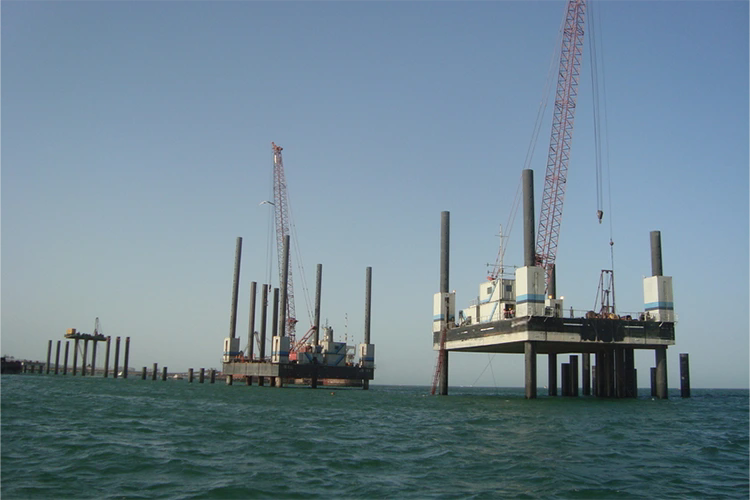
As a China manufacturer with 30+ years in marine construction, HAIDING SHIPYARD Jack Up Drilling Platform is a self‑elevating rig for exploration and development wells in water depths to 100 m. The drilling package handles 5,000‑m total depth with a mud system that maintains borehole stability through reactive shales, plus a rotary table delivering the torque needed for directional work. We ship the platform in road‑transportable sections – reducing site assembly time and getting you spudding weeks sooner than conventional rig moves.
When you are drilling 4,000 m below the seabed, a 0.1° deck tilt can put your wellbore 6 m off target. The HAIDING SHIPYARD supplies Jack Up Drilling Platform that holds platform level within ±0.05° through real‑time hydraulic leg compensation, reacting to wave motion before it affects the string. The rig floor carries a 5,000‑m drawworks, a 60‑kN·m rotary table, and a 120‑m³/h mud pump – all laid out so the driller stays focused on weight‑on‑bit and ROP, not on fighting hull movement. This is a drilling platform, not a lifting barge; every design choice starts with the wellbore.
How Does Platform Inclination Affect Deep Reservoir Targeting?
Onshore drillers take a fixed surface location for granted. Offshore, your “rig floor” sits on legs that can settle, shift under wind loads, or react to changing pipe rack weights. The metric that truly matters is not maximum depth – it is how much of that depth stays inside the pay zone.
A 0.1° tilt at surface produces a bottom‑hole position error of >6 m at 3,500 m. That error often puts the production section outside the reservoir, forcing a sidetrack that costs millions and consumes weeks of rig time. Even minor oscillation during connections can cause poor cement placement or casing misalignment.
The Jack Up Drilling Platform’s automatic leveling system (three‑axis inclinometer, accuracy ±0.02°) continuously adjusts each leg to keep the rig floor within tolerance. The MWD tool sends deviation and azimuth data to the driller’s screen every 30 seconds. If a squall hits, leg compensation reacts before the MWD records a change – so the well path stays smooth. This closed‑loop control is why wells drilled from this unit consistently show verticality deviation below 0.5‰, even through interbedded hard stringers that tend to push the bit off course.


Optimizing Mud Circulation and Solids Removal in Deep Wells
High-Pressure Pumping: Dual 120 m³/h pumps (one active, one standby) maintain >35 MPa pressure to lift cuttings from 5,000 m drill strings without eroding the borehole.
4-Stage Solids Control: A multi-stage train—shaker, desander, desilter, and centrifuge—removes drilled solids down to 5–7 microns.
ECD & Rheology Control: Centrifuge bypasses and high-shear mixing hoppers allow real-time mud adjustments during connections, preventing ECD spikes and fluid losses in overpressured shale.
Dual Tankage & Maintenance: Dedicated agitator tanks keep water- and oil-based muds homogeneous. Accessible overhead valves cut cleaning flat-time, sustaining daily ROPs of 200–300 m in soft rock and 80–100 m in abrasive formations.
Spud Legs That Understand Seabed Variability
Offshore seabed conditions vary widely across operating zones—from stiff clays in the North Sea and loose sands off West Africa to soft, compressible silts in Bohai Bay. Handling these soft upper layers and sudden storms without risking platform damage depends on four structural design choices:
Truss Leg Geometry: Four sectional truss-type legs (2.0–2.5 m diameter, lengths from 30 to 150 m) provide the structural rigidity required for varying water depths and seabed load distributions.
Punch-Through Prevention: Expandable spud cans with a contact area of ≥80 m² distribute pre-load weight evenly. This large footprint prevents punch-through—a sudden leg penetration that can tilt the hull and overload the jacking gear—and can be widened further based on site geotechnical reports.
Hardened Rack Metallurgy: The leg racks use quenched and tempered CCSB marine steel hardened to ≥200 HB, giving the gear teeth a 25-year service life against cyclic fatigue and saltwater stress corrosion.
Storm Survival Parameters: Full-load lifting speeds of 0.2–0.4 m/min allow rapid deck raising to clear incoming squalls. Combined with Grade 12 wind resistance and a 6 m wave tolerance, the Jack Up Drilling Platform stays locked on location through monsoon sea states that force floating vessels to disconnect.
Why 6 Sections Beat One Giant Hull?
Traditional jack‑up rigs require dedicated yards and heavy‑lift tow‑out. This Jack Up Drilling Platform is split into 6 to 8 modules – main deck, leg sections, drilling module – each ≤120 tons. That approach brings several practical benefits:
• Modules travel by truck, rail, or standard flat‑deck vessel to any port with a 150‑t crane.
• On‑site assembly takes 10–15 days using a floating crane and bolted flange connections (no field welding on primary structures).
• For multi‑well campaigns, you can have the first platform drilling while the second is assembled nearby.
• Sections are fully interchangeable – a damaged leg can be swapped without dismantling the entire platform, reducing downtime and extending service life.
Material Choice: Not Just Steel, But the Right Steel
The primary structure uses CCSB marine steel plate (yield ≥235 MPa) with main beam thicknesses of 50 mm and above. Deck areas subject to heavy mud tank and casing loads get a wear‑resistant modified version that resists surface abrasion from pipe handling.
Underwater protection is designed for long field life. The deep‑sea heavy coating plus sacrificial anode system provides 15‑year corrosion protection, matching typical field development cycles.
Low‑temperature toughness is built in: CCSB plate delivers ≥27 J impact energy at –20°C, allowing year‑round drilling in northern latitudes (e.g., Bohai winter). The mud system includes insulation and trace heating to maintain viscosity even when ambient temperatures drop below freezing – so you are not forced to suspend operations during the coldest months.
Detailed Technical Parameters
|
Parameter Category |
Specific Item |
Specification Range |
Remarks |
|
Basic Dimensions |
Total Platform Length (m) |
70-90 |
6-8 sections, single section length ≤15m |
|
|
Total Platform Width (m) |
25-30 |
Effective deck operation area ≥70% (including drilling module) |
|
|
Platform Depth (m) |
7.0-8.0 |
Ensures drilling module installation and mud tank space |
|
Lifting Performance |
Number/Type of Spud Legs |
4/truss-type |
Diameter 2.0-2.5m, material: CCSB marine steel plate |
|
|
Spud Leg Length (m) |
30-150 |
Adapted to 3-100m water depth, customizable |
|
|
Lifting Speed (m/min) |
0.2-0.4 |
Full-load lifting speed ≥0.2m/min |
|
|
Seabed Insertion Depth (m) |
≥12 |
Expandable spud can optional for soft soil (contact area ≥80㎡, CCSB steel plate) |
|
Drilling Performance |
Maximum Drilling Depth (m) |
≤5000 |
Vertical/directional well, drill pipe specification 5-1/2 inches |
|
|
Rotary Table Torque (kN·m) |
≤60 |
Maximum speed 120r/min |
|
|
Maximum Drill String Weight (t) |
≤300 |
Adapted to 5000m deep well load |
|
|
Mud Pump Parameters |
Flow rate 120m³/h, working pressure ≥35MPa |
Dual pump configuration, one in use and one standby |
|
|
MWD Measurement Accuracy |
Hole deviation ±0.1°, azimuth ±0.5° |
Real-time data transmission to drilling control room |
|
Load Performance |
Total Platform Load (t) |
3000 |
Including drilling equipment, mud, personnel and materials |
|
|
Deck Uniform Load (kN/㎡) |
70-80 |
Drilling module area load ≥120kN/㎡ |
|
|
Total Drilling Equipment Weight (t) |
≤200 |
Including drilling rig, rotary table, mud system |
|
Structure & Material |
Platform Material |
Main structure: CCSB marine steel plate; Deck: CCSB wear-resistant modified steel plate |
Main load-bearing beam thickness ≥50mm, yield strength ≥235MPa |
|
|
Anti-corrosion Treatment |
Deep-sea heavy anti-corrosion coating + cathodic protection |
Underwater anti-corrosion life ≥15 years |
|
|
Leveling Accuracy |
±0.05° |
Full-automatic hydraulic leveling system |
|
Safety Configuration |
Wind Resistance Grade |
Grade 12 |
Platform in raised state, drilling equipment windproof locking |
|
|
Emergency System |
Emergency generator (500kW), manual lifting device, well control system |
Including blowout preventer, choke and kill manifold |
|
|
Monitoring System |
Level, drilling parameters, wind speed, well pressure monitoring |
Data uploaded to shore-based command center in real time |
|
Certification Standard |
Product Certification |
ABS/CCS/DNV marine platform certification |
Complies withRules for Classification of Mobile Offshore Units &Oil Drilling Platform Safety Regulations |
Application Scenarios
Exploration wells in frontier basins – South China Sea / East China Sea, 50–100 m water depth, drilling to 5,000 m to test carbonate or turbidite reservoirs. Real‑time MWD and mud logs identify pay zones, reducing wireline runs and cutting evaluation time by 30%.
Development wells in mature fields – Bohai Bay / Beibu Gulf, 10–50 m depth, directional drilling to cover multiple fault blocks from a single location. The platform delivers 25% efficiency gain over older designs – faster tripping (connections under 2 min) and automated pipe handling reduce manual labor.
Workover and re‑entry operations – The derrick and substructure handle heavier loads for tubular recovery and fishing tools, eliminating the need for a separate workover vessel.


Engineering Adaptations and Through-Life Support Systems
Tailoring platform hardware to specific site challenges and maintaining operational readiness requires targeted structural modifications and global field support:
Structural Customization
Leg lengths (up to 150 m), spud can contact areas (≥80 m²), and crane lifting capacities are engineered to match site-specific water depths, soil bearing profiles, and heavy-lift requirements.
Severe Environment Packages
Cold-climate retrofits integrate low-temperature hydraulic fluids, insulated tankage, and trace-heated mud troughs for sub-zero conditions. High-temperature, high-pressure (HTHP) packages add reinforced blowout preventer (BOP) stacks and a secondary 70 MPa choke/kill manifold.
Global Logistics and Onsite Service
Regional spare parts hubs in Rotterdam, Singapore, and Houston stock high-wear components for rapid delivery, backed by onsite engineering dispatch within 48 hours to major offshore basins.
Operational Readiness
Telemetry systems provide real-time remote monitoring of hull tilt and jacking health, paired with structured pre-spud crew training to ensure operational safety from day one.


Frequently Asked Questions
Q: How does the Jack Up Drilling Platform handle directional drilling when the seabed is uneven?
A: We review the site geotechnical report and adjust the pre‑load sequence to avoid uneven settlement. The large‑footprint spud cans distribute pressure, and differential jacking can compensate for seabed slope before drilling starts.
Q: What happens if the mud pump fails while drilling a critical section?
A: An identical standby pump is connected through manifold valves – changeover takes <10 minutes. We stock spare liners, pistons, and valves onboard, and monthly pump inspections are scheduled to prevent sudden failures.
Q: Can the platform operate with a reduced crew for extended periods?
A: Automation covers drawworks, rotary table, and mud pump parameters, allowing one driller and one assistant to manage normal drilling. For trips and casing runs, we recommend a standard crew, but the layout reduces manual handling, enabling efficient operations with 20–25 personnel.
Q: How is well control ensured in deep, high‑pressure zones?
A: The well control system is independent of platform hydraulics, with a dedicated accumulator and dual BOP stacks (annular and ram). The choke manifold is rated to 70 MPa with a failsafe actuator. A full pressure test is conducted after each leg pre‑load, and our emergency procedures follow IADC deep‑water jack‑up guidelines.
Hot Tags: China Jack Up Drilling Platform Supplier , Factory
Send Inquiry
Contact Info
-
Address
No. 8888, Wanhong Avenue, Huanglou Sub-district, Qingzhou City, Weifang City, Shandong Province, China
-
Tel
-
E-mail
Submit your demand for dredgers, Sectional Barges or Tugboats to get instant quotation. HAIDING SHIPYARD meticulously monitoring every step of production to ensure quality and clear pricing, providing our customers with cost-effective solutions.